
“How Menus Shape Behaviour”: Claire Scullion on the Small Changes That Transform Hotel F&B
In hotel F&B, attention often goes to big moves - new concepts, major refurbishments, headline chefs.
Claire Scullion takes a different view.
“If you want to improve performance quickly, start with the menu.”
Not as decoration - but as a tool that shapes how guests think, feel and make decisions from the moment they sit down.
“The menu is the presentation of the brand that nobody can escape.”
Small Changes, Significant Impact
One of Claire’s earliest projects demonstrates just how powerful this can be.
Working with Whitbread’s restaurant brands, she redesigned menus using behavioural psychology - adjusting layout, structure and language.
Nothing else changed - no new dishes and no pricing adjustments.
Yet profitability increased.
“We didn’t change the food. We changed how choices were presented - and behaviour followed.”
It’s a useful reminder: before re-pricing or rebranding, look at how decisions are being guided.
The Friction Guests Don’t Talk About
Much of Claire’s work focuses on the small, often overlooked moments that quietly shape experience.
Lighting that makes menus difficult to read.
Overly complex layouts.
Too many options.
Or simply the way menus are introduced and removed during service.
“It’s not just what’s printed - it’s how people are guided through decisions.”
These are rarely headline issues. But collectively, they create hesitation, uncertainty and a lack of confidence.
Less Choice, More Confidence
One consistent finding: most menus are too large.
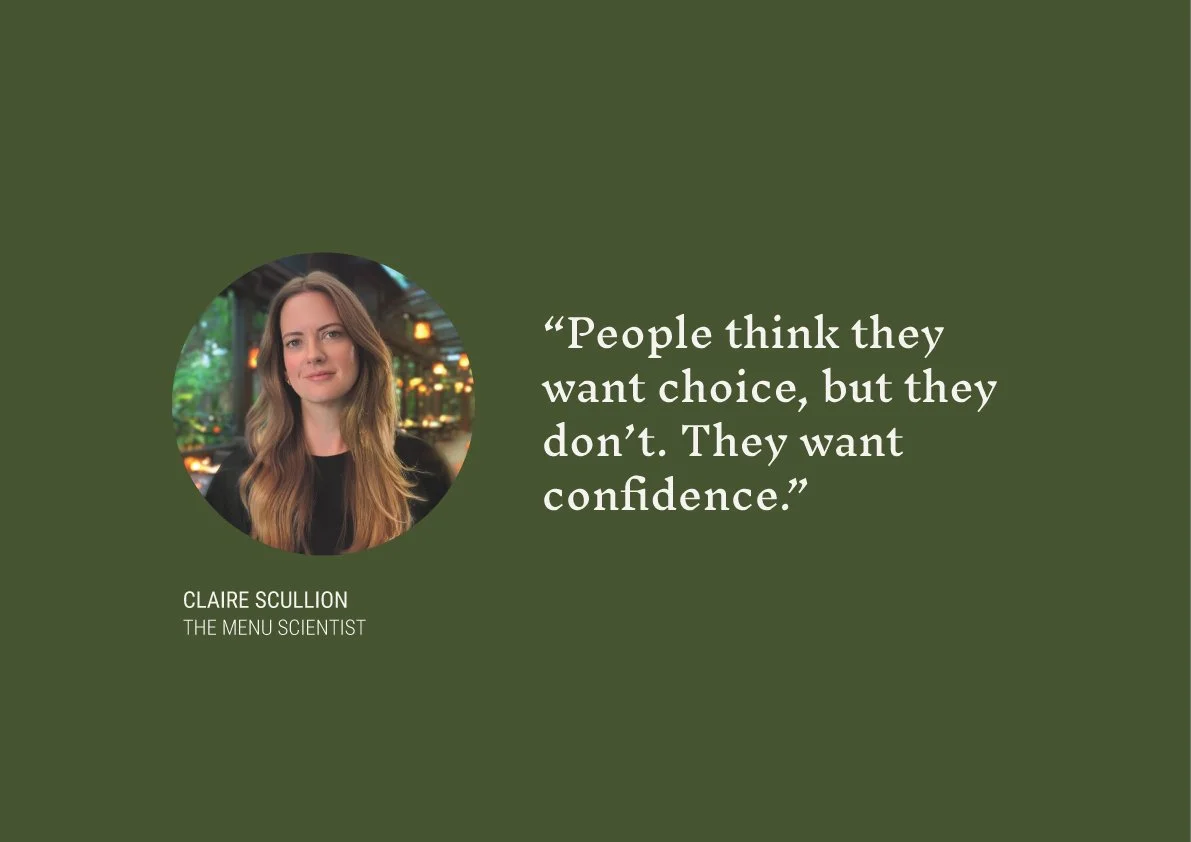
“People think they want choice, but they don’t. They want confidence.”
Large menus slow decisions, dilute identity and push guests towards safe - often less profitable - choices.
Stripping back, clarifying and focusing the offer typically improves both experience and performance.
A Problem of Ownership
In hotels, menus often suffer from too many voices.
Owners, chefs, brand teams and finance all contribute - but without clear ownership, decisions become diluted.
Claire’s advice is simple: define who is responsible, and how decisions are made.
Otherwise, exceptions quickly become the rule.
Start Small, Improve Continuously
Rather than overhauling everything, Claire encourages a more focused approach.
“With any menu change, you can realistically achieve one - maybe two - things.”
For example:
Improve drink sales.
Increase dessert orders.
Simplify the ordering journey.
Then measure, learn and iterate.
The One Thing Every Guest Experiences
For Claire, the menu is one of the few touchpoints every guest engages with - and one of the easiest to improve.
When it works, it creates clarity, confidence and flow.
And unlike many aspects of hotel F&B, it doesn’t require major investment.
Just better thinking.
This article is an extract from our wider report, Hotel F&B Insights 2026. You can download the full guide here.
